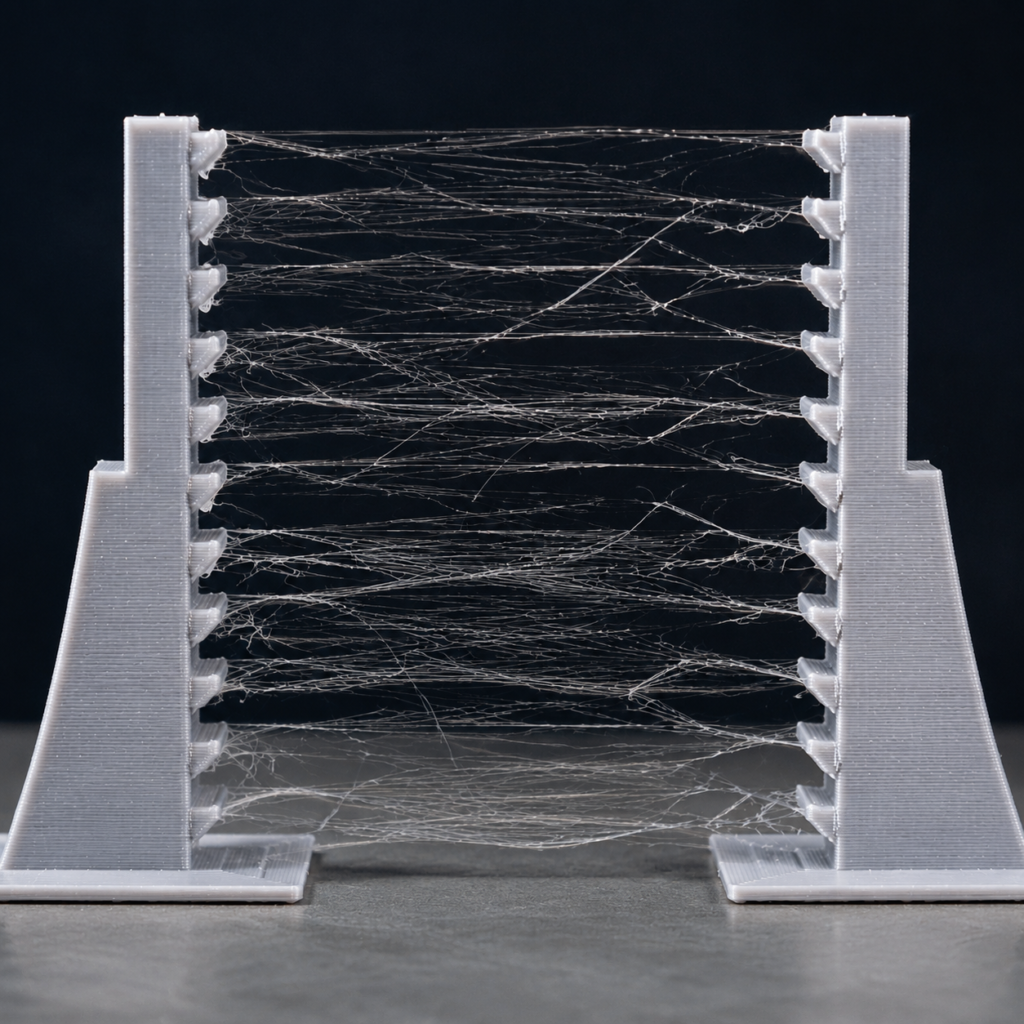
PLA vs PETG: Which Filament Should You Choose?
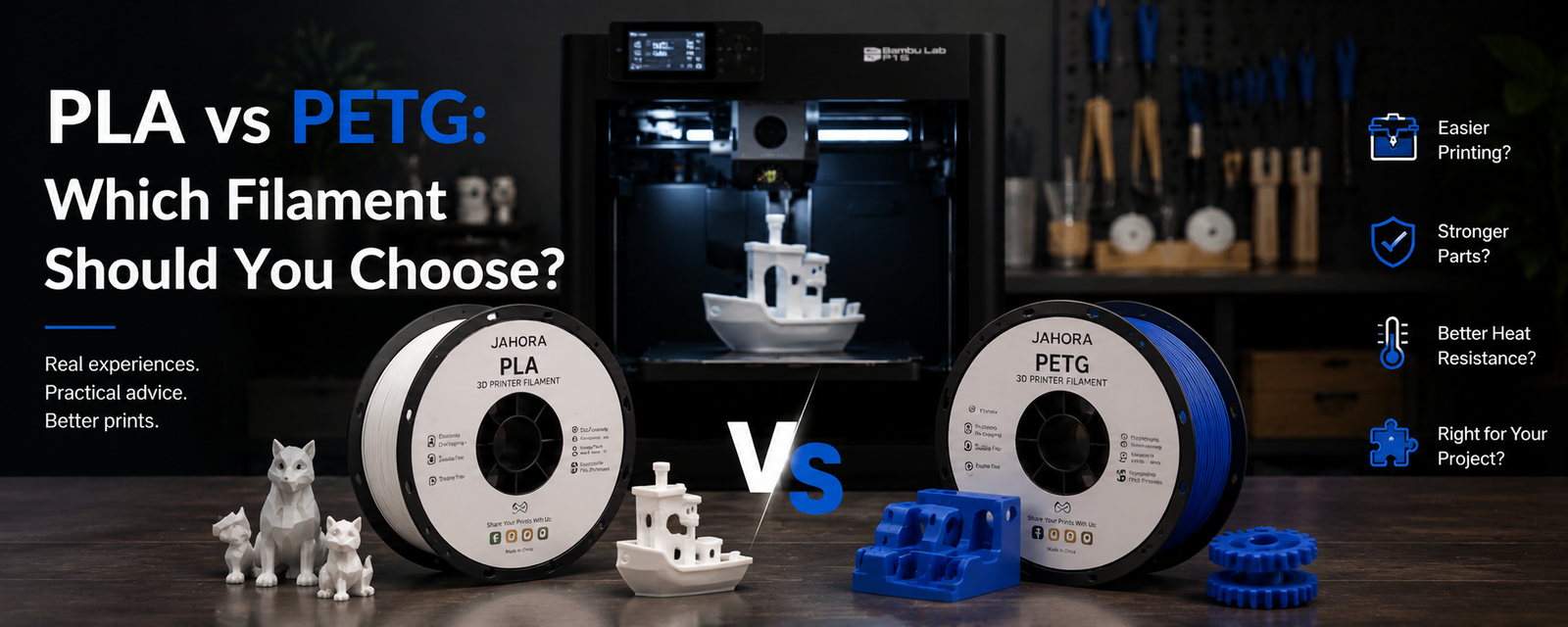
A few weeks ago, a customer emailed us after buying his first 3D printer.
His question was simple:
“I’m only ordering one spool to start with. Should I buy PLA or PETG?”
If you’ve spent any time in 3D printing communities, you’ve probably seen the same question asked over and over again. It appears in Facebook groups, Reddit discussions, Discord servers, and support emails almost every day.
After helping thousands of hobbyists, makers, and first-time printer owners choose filament, we’ve noticed something interesting. Most people aren’t really asking about materials. They’re asking about outcomes.
They want to know:
Will this print successfully?
Will it be strong enough?
Will it survive outdoors?
Will I spend more time printing or more time troubleshooting?
The challenge is that both PLA and PETG are excellent materials, but they solve different problems.
We’ve seen customers print beautiful display models with PLA that still look perfect years later. We’ve also seen customers print functional brackets in PLA, only to watch them deform after sitting in a hot garage for a few weeks. On the other hand, we’ve had customers switch to PETG for outdoor projects and tool holders, only to become frustrated by stringing and tuning issues during their first few prints.
That’s why there isn’t a one-size-fits-all answer.
The best filament depends on what you’re printing, where the part will be used, and how much printing experience you already have.
In this guide, we’ll share the same advice we give customers every day, including the strengths, weaknesses, and real-world tradeoffs between PLA and PETG, so you can choose the right filament for your next project.
Should You Choose PLA or PETG?
If you’re looking for the short answer, here’s the recommendation we give most first-time customers.
Choose PLA if:
You are new to 3D printing
You want the easiest printing experience
You primarily print decorative models, toys, miniatures, or prototypes
You care about surface quality and fine details
Choose PETG if:
You need stronger functional parts
Your prints will be used outdoors
The part may be exposed to heat
You need better impact resistance and durability
For most beginners, PLA is usually the better starting point.
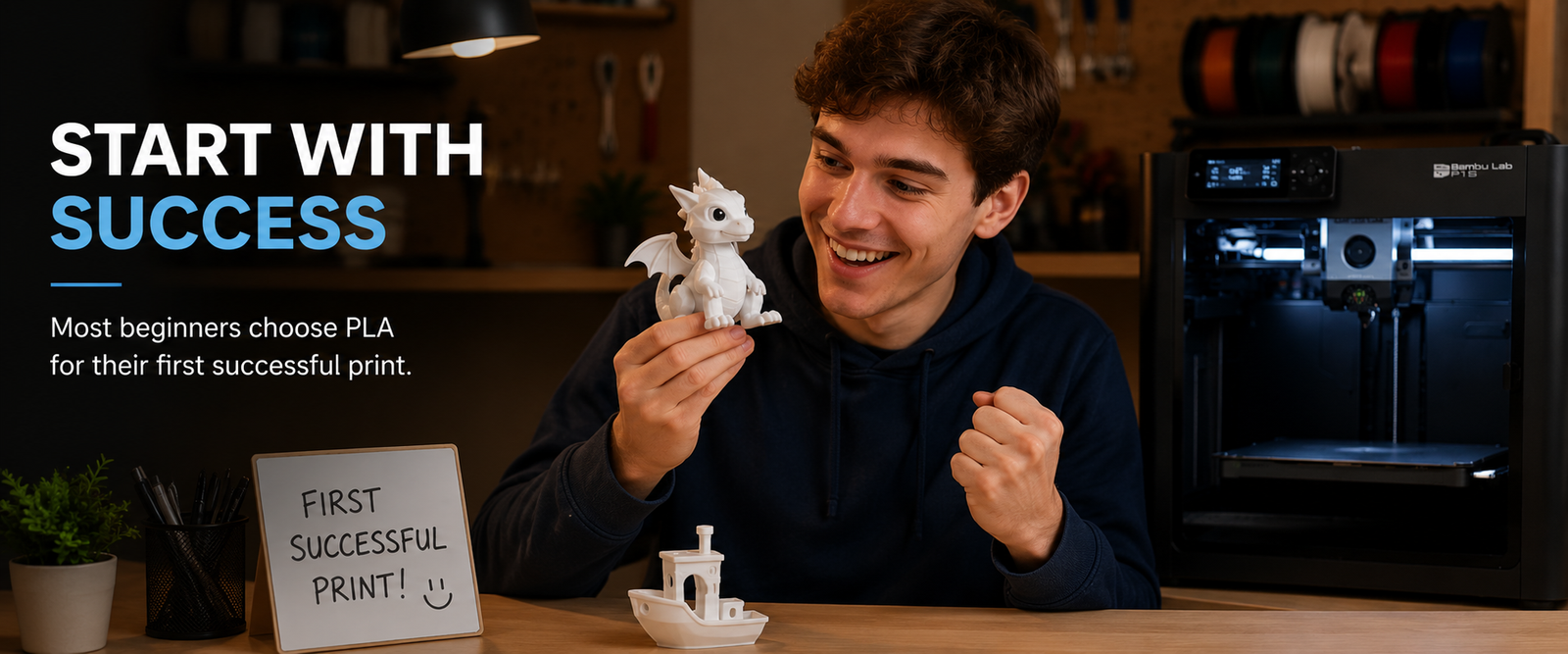
In fact, many of the successful first prints we see from new customers are made with PLA. It requires less tuning, produces cleaner results, and is generally more forgiving when printer settings aren’t perfectly optimized.
PETG, on the other hand, is often the material people move to once they start printing parts that need to do more than simply look good. Tool holders, garage organizers, outdoor brackets, and car accessories are all common examples where PETG becomes the better choice.
That doesn’t mean PETG is difficult to print. However, it typically requires more attention to temperature, retraction, and moisture control than PLA.
If you’re only buying one spool and you’re not sure where to start, our recommendation is simple:
Start with PLA.
Once you’re comfortable with your printer and understand basic settings, PETG becomes an excellent second material to add to your workshop.
| Best For | PLA | PETG |
|---|---|---|
| First-Time Users | ✓ | |
| Miniatures | ✓ | |
| Decorative Models | ✓ | |
| Functional Parts | ✓ | |
| Outdoor Projects | ✓ | |
| Garage Storage | ✓ | |
| Tool Holders | ✓ | |
| Easy Printing | ✓ | |
| Heat Resistance | ✓ |
Why Most Beginners Start with PLA
One thing we’ve noticed after helping customers choose filament is that most beginners aren’t looking for the strongest material.
They’re looking for their first successful print.
When someone buys their first 3D printer, they’re usually excited to start printing immediately. They don’t want to spend hours adjusting settings, troubleshooting stringing, or wondering why a print failed halfway through.
This is where PLA has a clear advantage.
PLA is one of the most forgiving materials available for FDM 3D printing. It prints at lower temperatures, sticks well to most build plates, and typically produces excellent results even when printer settings aren’t perfectly dialed in.
Many of the support requests we receive from new users follow a similar pattern. Someone starts with PETG because they’ve heard it’s stronger, but quickly becomes frustrated by issues like stringing, excess filament buildup, or poor first-layer adhesion. After switching to PLA, they often discover that their printer was working perfectly all along—the material was simply easier to manage.
That doesn’t mean PLA is only for beginners.
Even experienced makers continue using PLA for prototypes, display models, cosplay props, and decorative prints because it offers excellent detail and consistent print quality.
In fact, some of the most impressive prints shared by our customers are still made with PLA.
The reality is that a successful print is usually more valuable than a stronger material that never prints correctly.
That’s why, when someone asks us which filament they should buy first, PLA is usually the recommendation.
When PETG Is the Better Choice
While PLA is usually the material we recommend to beginners, there are plenty of situations where PETG becomes the better choice.
In fact, many customers eventually add PETG to their workshop after they start printing parts that need to do more than simply look good.
A common example is garage organization.
We’ve seen customers print tool holders, battery mounts, wall organizers, and storage brackets that work perfectly in PLA during the winter. But once summer arrives, especially in warmer states, those same parts can begin to soften or deform over time.
PETG handles these conditions much better.
Its higher heat resistance and improved durability make it a popular choice for functional parts that are exposed to daily use, sunlight, or changing temperatures.
Outdoor projects are another area where PETG shines.
Whether it’s a garden clip, camera mount, cable organizer, or weather-resistant bracket, PETG generally survives outdoor environments longer than PLA.
We’ve also noticed that many makers who own multiple printers often follow a simple rule:
If the part is mainly decorative, they print it in PLA.
If the part has a job to do, they print it in PETG.
Of course, PETG isn’t perfect. It can be more prone to stringing and usually requires more tuning than PLA. But for applications where strength, durability, and heat resistance matter, the extra effort is often worth it.
That’s why PETG remains one of the most popular materials for functional 3D printing projects.
| Project | Recommended Material |
|---|---|
| Display Models | PLA |
| Miniatures | PLA |
| Cosplay Props | PLA |
| Tool Holders | PETG |
| Garage Organizers | PETG |
| Outdoor Brackets | PETG |
| Camera Mounts | PETG |
| Car Accessories | PETG |

Why We Rarely Tell Customers One Material Is Better
One question we hear all the time is:
“Which filament is better, PLA or PETG?”
The honest answer is that we rarely answer that question directly.
Not because we’re avoiding it, but because the answer depends entirely on what you’re trying to print.
For example, someone recently asked us for a recommendation for printing display models and desk decorations. In that case, PLA was an easy choice. It produces excellent detail, prints consistently, and is usually the fastest way to get a great-looking result.
Later that same week, another customer was looking for filament to print tool holders for a garage workshop. The recommendation was completely different. Since those parts would be supporting weight and dealing with changing temperatures throughout the year, PETG made far more sense.
Neither customer was making the wrong decision.
They simply had different goals.
This is where many online discussions become confusing. People often compare PLA and PETG as if one material is supposed to replace the other. In reality, most experienced makers end up using both.
A decorative model sitting on a shelf has very different requirements than a wall-mounted tool organizer. A cosplay helmet has different needs than a camera mount that’s left outdoors all summer.
Once you start thinking about the project instead of the material, the decision becomes much easier.
In our experience, customers who choose filament based on the actual use case tend to be much happier with the final result than those who focus only on strength, temperature ratings, or material specifications.
If you’re still deciding, you can explore our PLA filament collection here or browse our PETG filament collection here to see the types of projects each material is commonly used for.
Where PLA and PETG Feel Different in Everyday Printing
Specifications can be useful, but they don’t always tell the full story.
What matters more is how the material behaves when you’re actually standing next to the printer, watching a project come to life.
PLA is often the material that gives people confidence early on. The first layer usually goes down easily, prints tend to finish with fewer surprises, and the final result often looks exactly the way you expected.
PETG feels different.
It’s not uncommon for someone printing PETG for the first time to notice fine strings between parts, extra cleanup after a print, or the need to adjust temperatures and retraction settings. None of these challenges are particularly difficult to solve, but they are things that many PLA users never have to think about.
On the other hand, PETG often rewards that extra effort with parts that feel tougher and more durable in everyday use.
This difference is why many makers naturally develop a simple workflow over time.
When appearance, detail, and ease of printing matter most, they reach for PLA.

When strength, durability, and long-term performance become the priority, PETG often becomes the preferred choice.
Neither approach is right or wrong.
They’re simply different tools for different jobs.
Understanding that distinction is often more valuable than memorizing material specifications or comparing strength numbers on a chart.
Common Printing Problems We Hear About Every Week
One thing we’ve learned after helping thousands of makers is that most printing problems aren’t caused by the printer itself.
In many cases, the issue comes down to material selection, storage conditions, or simply using the wrong filament for the job.
Some of the most common questions we receive include:
* Why does my PLA filament keep snapping during printing?
* Why does my PETG string so much?
* Why are visible layer lines showing up on my prints?
* Why does my PETG nozzle keep clogging?
* Why is the filament not feeding smoothly through the extruder?
* Why did my print suddenly stop extruding halfway through the job?
* Why does one material print perfectly while another seems impossible to dial in?
The good news is that these problems are usually fixable.
For example, brittle PLA is often related to moisture absorption and storage conditions. PETG stringing is commonly caused by temperature, retraction settings, or wet filament. Clogged nozzles can result from contaminated material, excessive heat, or residue left behind from previous prints.
The challenge is that every problem has multiple possible causes, which is why troubleshooting often feels frustrating when you’re new to 3D printing.
That’s also why we continue adding practical guides and troubleshooting resources based on the questions customers ask us most frequently.
If you’re looking for filament recommendations, printing tips, or answers to common 3D printing problems, you can always start from our homepage here, where we regularly share new guides, materials, and printing advice for both beginners and experienced makers.
Which Filament Should You Choose for Different Projects?
After all the comparisons, the question still comes back to one thing:
What are you actually printing?
In our experience, choosing the right filament becomes much easier when you start with the project instead of the material.
If you’re printing miniatures, decorative models, cosplay props, or display pieces, PLA is usually the easiest and most practical choice. It produces sharp details and requires less tuning to achieve excellent results.
If you’re printing tool holders, wall organizers, outdoor brackets, camera mounts, or replacement parts that need to withstand everyday use, PETG is often the better option.
Many makers eventually stop asking whether PLA or PETG is better and start choosing materials based on the purpose of the print.
That’s usually when the frustration disappears and the printing experience becomes much more enjoyable.
| Project | Recommended Material |
|---|---|
| Miniatures | PLA |
| Cosplay Props | PLA |
| Decorative Models | PLA |
| Prototypes | PLA |
| Tool Holders | PETG |
| Outdoor Brackets | PETG |
| Camera Mounts | PETG |
| Garage Organizers | PETG |
| Car Accessories | PETG |
Most Makers Eventually Reach the Same Conclusion
One interesting thing we’ve noticed over the years is that the PLA vs PETG debate tends to matter less as people gain experience.
When someone first enters the hobby, it’s easy to spend hours comparing specifications, watching YouTube videos, and trying to figure out which material is objectively better.
Most experienced makers don’t think that way anymore.
They’ve learned that filament selection is usually one of the easiest decisions in the entire printing process.
If the project needs to look great, print easily, and capture fine details, PLA is often the obvious choice.
If the project needs to survive daily use, handle heat, or function as a working part, PETG often becomes the natural option.
After a while, the decision becomes almost automatic.
The conversation shifts away from “Which filament should I buy?” and becomes “What does this part need to do?”
That’s usually the point where people stop worrying about materials and start enjoying the creative side of 3D printing.
In fact, many long-term makers keep both PLA and PETG on hand and simply choose the one that best matches the project in front of them.
If you’re still exploring different materials, you can browse our filament collections here to see how different makers use PLA and PETG for completely different types of prints.
Final Thoughts
When people first get into 3D printing, choosing between PLA and PETG can feel like a much bigger decision than it actually is.
We’ve seen countless discussions online comparing strength ratings, temperature resistance, and material properties as if one filament is supposed to replace the other.
In reality, both materials have earned their place on the workbench.
Some of the most impressive prints we’ve seen from customers were made with PLA. At the same time, many of the toughest functional parts we’ve encountered were printed in PETG.
The difference wasn’t the filament itself.
It was how well the material matched the job.
If there’s one takeaway from this guide, it’s this:
Don’t choose a filament because someone says it’s the strongest.
Choose it because it’s the right tool for the project you’re working on.
That’s the approach experienced makers eventually arrive at, and it’s usually the approach that leads to the fewest failed prints and the best long-term results.
Whether you start with PLA, move to PETG, or keep both on hand, the most important thing is to keep printing, keep experimenting, and keep learning from each project.
That’s how every experienced maker started.
Continue Your 3D Printing Journey
Whether you’re printing your first Benchy or building functional parts for daily use, choosing the right material is only one part of the process.
If you’d like to learn more about filament settings, troubleshooting, and material comparisons, explore the articles below.
Related Articles
• Why Is My PLA Filament Brittle?
• Best PLA Settings for Beginners
• PETG Temperature Guide
• PLA vs PETG for Outdoor Use
Looking for filament for your next project?
Browse our Filament Center here to explore PLA, PETG, TPU, Silk PLA, and other materials used by makers every day.
Need replacement nozzles, extruder gears, hotend components, or printer upgrades?
Visit our Accessories Center here.
Still not sure which material is right for your printer or project?
Contact us here and our team will be happy to help.